

Spielberg `hungry' to work
 | Terry Armour |
Published July 16, 2006
Sure, filmmakers want to be recognized for their work. They'd also like to make people think. And, sometimes, they simply just want to entertain.
But an award every now and then sure wouldn't hurt.
"It's a mild form of benign narcissism," said Oscar-winning filmmaker Steven Spielberg, who on Saturday received a Lifetime Achievement Award at the Chicago International Film Festival Summer Gala.
These words from the man who gave us "E.T.," "Saving Private Ryan," "Schindler's List," and "Munich"--just a few of the films for which Spielberg was honored at Saturday's affair, also attended by actors Roy Scheider and Cuba Gooding Jr.
"I don't really think people realize what an artist he has become," said Scheider, who worked with Spielberg in the 1975 classic "Jaws." "Time will show that--history will show that, when his films are looked at the way John Ford's . . . or Stanley Kubrick's are looked at."
But Spielberg says he has a long way to go to be mentioned in the same breath as Kubrick, Ford and other legends.
"Every time I go to something like this, it really reminds me that I haven't made my `Lawrence of Arabia' yet--I haven't made my `Grapes of Wrath' yet. It makes me hungry. I will go home from this with a healthy appetite to keep working."
----------
The Personals page was compiled by Cheryl Bowles from Tribune news services and staff reports.
| | |
| |
| |
| |
| |
| |
| |



| Gila Almagor thrives in her 'paradise'
For Gila Almagor there's no place like Israel: 'When I wake up in the morning to do my work as an actress, this is a paradise, a land of endless opportunities.' In an interview she speaks about Munich production, Spielberg and more When Gila Almagor hears Steven Spielberg’s Munich labeled anti-Israel, she laughs. “It’s a film, it’s a film, it’s a film - t’s not a documentary,” says the legendary Israeli actress, who has a small but critical role in the movie. “It was done by a great director, a great filmmaker, and a man who loves Israel.” Almagor plays the mother of the lead Mossad assassin in Munich, which focuses on the Israeli government’s secret mission to kill the terrorists responsible for the 1972 Munich Olympics massacre (Operation Wrath of God). She speaks glowingly of her on-screen son, Australian actor Eric Bana. “When I come to a set, I come to do my work, so I appreciate and respect actors who concentrate on what they have to do - that’s what I like about Eric,” says Almagor. “He’s highly intelligent, very polite, very good partner, and he looks just like an Israeli. I’m completely unknown to an actor like him, but he had no airs and was very good to work with.”
Gila Almagor (Photo: Gerard Alon)
Of course, to Israelis and aficionados of Israeli cinema, Almagor is a superstar. Her résumé includes such memorable Israeli films as Sallah Shabati (1964), Siege (1969), The House on Chelouche Street (1973), Operation Thunderbolt (1977), Life According to Agfa (1992) and Passover Fever (1995). Munich isn’t Almagor’s first Hollywood screen credit; she appeared in the 1982 miniseries A Woman Called Golda with Ingrid Bergman, and four years later, she acted opposite Tom Hanks in Every Time We Say Goodbye. Almagor has also appeared in numerous theater productions in Israel and abroad, having made her debut at age 17 in The Skin of Our Teeth at the Habima Theater. Actor and a writer Almagor’s first book for young adults, the autobiographical The Summer of Aviya, was incorporated into the Israeli public school curriculum and adapted into both a film and a touring one-woman show (she brought the stage production to Broadway in 2003). The book’s sequel, Under the Domim Tree, was also added to the Israeli Education Ministry’s required reading list and adapted into a film in which Almagor starred. Her accolades include Hadassah’s Woman of Distinction Award, the Israeli Film Academy’s lifetime achievement award and the highest Israeli civilian honor, the Israel Prize. In addition to performing and writing, Almagor, 66, also founded the Gila Almagor Wishes Foundation, which grants requests to child cancer patients, and received the President’s Merit Award for Volunteers. She lives in Tel Aviv with Yaakov Agmon, her husband of more than 40 years and the former chief executive officer of Habima, with whom she raised a stepson, Idan, and an adopted daughter, Hagar. For five years, Almagor held the arts and culture portfolio on the Tel Aviv-Yafo City Council, and says, “I can assure you - what you can see in one night in Tel Aviv you can hardly see in New York or London.” 'You are what we prayed for' For Almagor and the other Israeli actors in Munich, working with Spielberg was a career milestone. “This was a gift, a dream, to work with a man like Steven Spielberg. We’re a small community of actors, and everybody was taken with his personality and his generosity and his curiosity about our lives in Israel.” Munich attracted controversy before and after its release, much of which baffled Almagor. “The negative buzz against Munich started long before the film came out,” she recalls. “People who never saw the movie spoke out against it - I was so shocked.”
Remember Munich (Photo: Reuters) “This film makes you think about revenge and endless bloodshed,” Almagor says. “You cannot kill Israelis and get away with it, and I’m totally against terror, but when the Mossad started the operation, nobody thought that it would go on for years. We hit them, they hit us; they kill us, we kill them…We are here to live. We raise our children and we hope for better days, and every day, we are losing our best sons and they’re losing their sons - this is what bothers me so much.” Toward the end of Munich, Almagor’s character delivers what the actress calls “the most pro-Israeli words one can say.” The character tells her son: “Everyone in Europe died -most of my family…I didn’t die because I came here. When I arrived I walked up to the top of a hill in Jerusalem and prayed for a child. I never prayed before but I was praying then, and I could feel every one of them praying with me. "You are what we prayed for. What you did you did for us - you did for your daughter, but also for us. Every one of the ones who died, died wanting this. We had to take it, because no one would ever give it to us - a place to be a Jew among Jews subject to no one. I thank God for hearing my prayer…Whatever it took, whatever it takes, a place on earth - we have a place on earth. At last.” Family history Like her character in Munich, Almagor lost many relatives in the Holocaust. Her mother lost 147 members of her extended family in Poland. Almagor’s mother and uncle escaped to Palestine and one of her cousins survived Auschwitz; the rest of the family perished. Almagor’s family history, as well as her membership on the Yad Vashem board of directors, have made her especially grateful to Spielberg for his efforts to keep the memories of Holocaust victims alive. “What he did for the Jewish people with Schindler’s List and what he did afterward with the video bank of survivor memories…We owe him so much. To say that he is anti-Israeli or anti-Jewish is nonsense.” The Munich scenes set in Israel, including Almagor’s, were filmed in Malta, but she wishes they were shot in the Jewish state. “I thought, ‘Look how much money Malta is getting now because this work isn’t being done in Israel,’” Almagor recalls. She hopes peace will bring more Hollywood productions to Israel. “I hope that we will have better days. There was a time when many big international productions were shot in Israel. We have so many talented actors and technicians and people who have lots of experience in filmmaking. Just come - everybody’s welcome.” At the end of Munich, the main character leaves Israel behind to settle in Brooklyn, N.Y., something Almagor terms “very sad.” She says, “I would like to think that after a while in Brooklyn, he’ll be back because the best place - the only place on earth and the best place under the sun - is here. After the army, our youngsters go to remote places - to the jungles, to India, to South America - and after a few years they come back, because as I said in the movie, it’s the only place where we can live as Jews among Jews with no conditions. This is our place.” This is a paradise In the Feb. 19 edition of Yedioth Ahronoth, Spielberg called Almagor “amazing” and added, “I would like to bring her to the States to work here, once I find the right role for her.”
When asked if she will return to Broadway, Almagor responded, “I might. I love doing my work and wherever it takes me, I go.”
(07.16.06, 11:03) | ||||

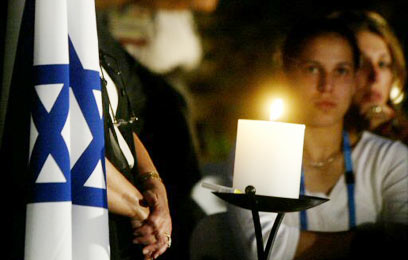
The man who investigated Lockerbie for PanAm has turned to writing fiction. Some say that is the right word to describe his past as one of Mossad's 'Wrath of God' hitmen. Andrew Mueller sifts the evidence
It is best with Juval Aviv to begin with what is verifiable. There is the man: a genial, charming, dapper grandfather, holding court in a Westminster hotel café. There is the book: Aviv's first novel, Max, an entertaining blockbuster which unravels an extraordinary conspiracy behind the mysterious death at sea of a thinly disguised newspaper baron called Maxwell Robertson. There is the day job: Aviv bears a folder of press releases that chronicle the doings of his investigation firm Interfor, which he founded in New York in 1979, and list his appearances as pundit and lecturer holding forth on security and terrorism (he has written two books on personal security, Staying Safe and The Complete Terrorism Survival Guide).
And then there is the back story. Aviv's press biography puts it like this: "Before founding Interfor, Mr Aviv served as an officer in the Israeli Defence Force (Major, retired), leading an elite commando/intelligence unit, and was later selected by the Israeli Secret Service (Mossad) to participate in a number of intelligence and special operations in many countries in the late 1960s and 1970s."
Behind this bland resumé lurks one of the great legends of modern espionage: Operation Wrath of God, the - always officially denied - campaign, launched by Israel in the wake of the 1972 Munich Olympics massacre, to hunt down and kill alleged Palestinian terrorists around the world.
Wrath of God was the beginning of a distinctively Israeli defence policy, of targeting individuals instead of institutions. It has been echoed in any number of assassinations of prominent figures in Hamas and Islamic Jihad, and in last week's suggestions that the Hizbollah leader, Sayyed Hassan Nasrallah, is on Israel's target list as its onslaught against Lebanon intensifies. Interest in Wrath of God was recently reinvigorated by Steven Spielberg's Munich, which was based substantially on George Jonas's 1984 book Vengeance, which in turn was based substantially on the recollections of Juval Aviv. It is commonly assumed that Aviv is the model for Avner, the central character played by Eric Bana in Munich: a patriotic assassin plagued by doubts as the body count climbs without making his country noticeably safer.
"I can't tell you that I am Avner," says Aviv. "There is no statute of limitations for those events. But I think the film is very accurate. It's a true account of the inner workings, the issues the agents had during the operations."
There are those who dispute this. Yossi Melman, an Israeli author and journalist who specialises in intelligence issues, has alleged that the highest Aviv rose in Israel's security apparatus was to the position of gate guard for El-Al. Aviv ascribes Melman's animus to his refusal to co-operate on a book. Melman, contacted for this article at Haaretz newspaper, retorts: "Juval Aviv is lying. I never asked him to write a book together."
General Zvi Zamir, head of Mossad at the time of Munich, has denied knowing Aviv - but then secret services are not known for identifying past employees ordered to carry out extra-judicial executions on the soil of friendly nations (Wrath of God victims fell in Italy, France and Cyprus, among other places).
"When I took the mission on," says Aviv, "I was told, and I understood, and I accepted, that we were creating a team which had deniability. Israel doesn't want to be officially associated."
Aviv is convincing. He recalls the meeting at which Israel's then Prime Minister, Golda Meir, turned his team loose, discusses the emotional impact of Spielberg's film on his family, and the persistent spectres that haunt his memory. If his rendition of a morally uncertain assassin is an act, it's up there with Eric Bana's stellar turn in Munich.
"I'm not proud of that part of my life," he says, "but if I had to do it again I probably would, because at that time, under those circumstances... I think it was a good idea to start with. It was more an emotional reaction, of getting revenge. But did it save the world? No. That's the frustration, you go through those things, you lose comrades..."
He shrugs, and offers another sad smile. Aviv still visits Israel regularly, but seems to have lost the righteous certainty that once kept his pistol hand steady.
"Terrorism," he says, "is a weapon of the poor. The mechanism of armies is not going to win. The thinking about Israel creating those small teams like ours was psychological, to scare people, to make it clear we could do anything they could do, so why don't we both stop. That was naive. When you don't have anything to eat, when you don't have any future, you don't care about the odds, and you don't think about tomorrow, because in your mind there is no tomorrow."
As we talk, Israel is sending its armies into Gaza in retaliation for the capture of one Israeli soldier, and not for the first time resembling a man attempting to swat wasps with a sledgehammer. A few days after our meeting, and Hizbollah has upped the ante by capturing two Israeli soldiers, prompting a similarly spectacular, and nigh-certainly futile, military response. Asked what he'd have told Golda Meir then if he knew what he knows now, Aviv replies: "Israel should have gone out of their way to help Palestinians into the 20th century. We had an opportunity. We could, with them, have gone to the rich nations and said we are in a war that will never end, unless there is an economic solution. The Marshall Plan is missing. The only way to beat it is economically. Give them hope. Every time we kill someone, two others take their place. Are we going to do this for ever?"
Aviv now claims to be helping America with its war on terror, as a consultant to the CIA - indeed, he sports a CIA lapel pin (the CIA's public affairs officedeclines to comment on any association). Aviv's press pack includes a copy of a certificate of appreciation from the FBI for "exceptional service in the public interest", which Aviv says is a reward for his service as a consultant (the FBI's public affairs office notes that these are also often issued to guest speakers).
What is beyond doubt is that Aviv played a major role in one terrorism story. He and his company were retained by PanAm to investigate the Lockerbie bombing. Aviv concluded the perpetrators were not the Libyans eventually convicted, but Iran-backed Palestinian terrorists who were able to smuggle their bomb on board due to a drug-running operation that the CIA was allowing to proceed for intelligence-gathering purposes.
"Lockerbie will be the next book," he says. Aviv wants to redeploy the same central character, a disaffected Mossad agent called Sam Woolfman, in a series of novels based on Aviv's investigations and experiences as a Mossad operative. Given the author, any reader will find themselves wondering whether Aviv is seeking to spin entertaining yarns, or attempting to smuggle extraordinary, scandalous, belief-beggaring truth inside fiction.
"I don't want to cherry-pick what is real and what isn't," he smiles. "If I wanted to do that, I would write non-fiction, but I wouldn't survive. I'm not stupid."
'Max' by Juval Aviv is published by Century (£11.99)
Briefing: Speaker, writer, soldier, spy
Juval Aviv was born in Israel in 1947. He has been CEO of New York-based investigations firm Interfor from 1979 to the present, in which capacity he has undertaken many high-profile cases, including heading PanAm's investigation into the Lockerbie bombing. Before that, he served in the Israeli Defence Force, attaining the rank of major, and in Mossad during the 1960s and 1970s, during which time he is believed to have been part of Operation Wrath of God. He is also a consultant and pundit on terrorism and security